
Red Lentil Dhokla: It's Easy, Protein-rich and So Tasty
Soak Lentils in equal amount of water; chop red sweet mini pepper, ginger and tomatoes cook briefly with cumin seeds; blend soaked lentils and pepper-tomato mixture; stir in seasonings; prepare steamer; add ENO to the batter and steam in greased steaming plate for 20 min. Make mustard-sesame seeds Tadka. Cut the cooled Dhokla and spread Tadka over it. Serve with Chutney, and tea/coffee. Enjoy!
Equipment
- Electric Blender also called Mixer/Grinder
- microwave oven to cook pepper-tomato mixture; if not available, follow stove-top cooking details given in Recipe directions.
- Microwave safe glass/ceramic bowl Cereal bowl size, to briefly cook the pepper-tomato mixture; I do NOT recommend using a plastic bowl for doing this
- Steamer If not available, see Recipe Notes for an alternative steamer assembly
- 1 8 inch (20 cm) stainless Thali/cake pan 1 1/2 - 2 inch high sides; for steaming the Dhokla; I do NOT recommend using uncoated Aluminum Thali/pan for doing this: the acidic batter reacts with the Aluminum - not good!
- Parchment paper cut into a round to fit perfectly on the inside of the Thali/pan
- Small wok/pan to make the Tadka
Ingredients
For Soaking the Lentils
- 1/2 cup Red Lentils Masoor Dal, skinless
- 1/2 cup Water
To cook briefly
- 2 tbsp Sweet mini pepper - deep Red: 1 medium-sized, chopped if not available, use 2 tbsp chopped red bell pepper
- 1/4 cup Tomatoes - chopped about 1/2 medium Roma
- 1 tsp Ginger; chopped about 1/2 inch piece
- 1/2 tsp Cumin seeds
- 1/4 cup Water
To add to Dhokla batter
- 2 tbsp Rice flour
- 2 tsp Sugar
- 1/2 tsp Salt may need to add up to 1/8 tsp more later
- 1/2 tsp Kashmiri (Red) Chilli Powder - medium spicy or 3/8 tsp regular red chilli powder; or a mixture of (1/4 tsp Cayenne + 1/4 tsp Paprika)
- 1/4 tsp Black Pepper - freshly crushed preferred
- 1/4 tsp Citric acid
- 1 tsp Oil I like peanut oil, any other neutral flavored oil OK
To Grease the Dhokla Steaming plate
- 1/2 tsp Oil I like peanut oil, any other neutral flavored oil OK
Just before Steaming
- 2 tsp Water
- 1 tsp ENO: Fruit Salt generally available at Indian grocery stores; if not available, see Recipe Notes for an easy DIY mixture; Always check to make sure the ENO is fresh, free flowing and not hard or lumpy! If so, discard it and use a fresh sachet or open a new jar.
To spread on the Dhokla after steaming
- 2 tbsp Water
- 1/16 tsp Salt
- 1/8 tsp Sugar
For the Tadka
- 2 tsp Oil I like peanut oil, any other neutral flavored, heat-stable oil OK (with high smoke point)
- 1/4 tsp Mustard Seeds (black/brown) - small sized seeds preferred can use extra 1/4 tsp if you like
- 1/2 tsp Sesame Seeds - Brown preferred if not available, polished white OK; I do NOT recommend black sesame seeds for this recipe
- 1/4 cup Water
For Garnish
- 1/8 tsp Red Kashmiri chilli powder If not available, use Paprika; do not use Cayenne here - it will become more spicy!!
- 2 tbsp Fresh Coriander leaves (Cilantro) - chopped If not available, OK to omit, but highly recommended. Do NOT use dried coriander - it has no real flavor and looks very dull! You can use a little bit of finely sliced green onions (scallions- green part) if you like
- 1 tbsp Coconut: fresh, grated (optional) frozen & thawed OK; If not available, OK to omit
Instructions
Soak Red Lentils (Masoor Dal)
- Rinse 1/2 cup Red Lentils (Msoor Dal) 2-3 times with fresh water, until the rinse-water is mostly clear. Drain the rinse-water completely - use a mesh strainer.Add 1/2 cup lukewarm water to the strained, rinsed lentils - measure carefully! Note: Do NOT simply estimate: the exact amount of water matters!Cover and set aside for 30-40 min to soak (overnight soaking is OK as well - do not add more water!)

Prep the pepper, ginger and tomatoes
- Rinse and slice a deep red sweet mini pepper. Remove the seeds, Also collect the red bits from near the stem. Chop/dice the de-seeded pepper.

- Chop 1/2 of a medium tomato (1/4 cup) and a small 1/2 inch (1 cm) piece of fresh ginger (1 tsp chopped).

- Place the chopped pepper, tomatoes and ginger in a microwave-safe glass/ceramic bowl. Add 1/2 tsp cumin seeds and 1/4 cup water.

- Microwave, covered, on Hi for 20 seconds, then on 30% power (defrost setting) for 2 min. Set aside to cool to room temperature.Note:If a microwave is not available, cook the mixture in a small saucepan on the stove-top, covered, on low heat for 4-5 min. Set aside to cool to room temperature.

Make the Dhokla batter
- Transfer the soaked lentils, along with any liquid left un-absorbed at the bottom of the bowl, to a blender jar.Add the cooled (cooked) tomato-pepper mixture.

- Blend to a smooth batter: open the lid, take out a little bit with a spatula and check the texture of the batter between your thumb and forefinger: it should feel super-smooth, not grainy. Now run the blender for about a minute longer: this will aerate the batter and make it light and fluffy.Note: Do NOT add any more liquid while blending! You shouldn't have any trouble blending it.

- Transfer the batter to a medium mixing bowl. (1 1/2 quart/L).

- To the batter, add:2 tbsp rice flour, 2 tsp sugar, 1/2 tsp salt, 1/2 tsp Kashmiri red chilli powder, 1/4 tsp black pepper (freshly ground preferred), 1/4 tsp citric acid

- Stir well with a whisk to mix evenly.

- Set aside for 10 min to hydrate.

Prepare the steamer assembly
- Meanwhile, prepare the steamer assembly.Add about 4 cups water to the steamer pot. Start heating, to bring the water to boiling.Note: If a steamer is not available, you can improvise. See Recipe Notes for details.

- Prepare the steaming plate: an 8-inch (20 cm) round stainless steel Thali/cake pan lined with a round piece of parchment. Place 1/2 tsp oil on the parchment and with your fingertips, spread it out on the paper, as well as the sides of the Thali.Note: If parchment paper is not available, you will need to grease the plate a bit more generously, using about 1 tsp oil. (Otherwise, it will be difficult to remove the Dhokla from the plate after steaming.)

- Prepare the Dhokla batter for steaming:NOTE: Be sure to check the activity of the ENO powder: Sift it though a mesh strainer: if it is hard and/or has lots of lumps, it is probably old and not very active. Do NOT use this: it will RUIN your Dhokla, because it will NOT become spongy! (See the lumps in the strainer in the picture - this is NOT desirable!)(Use a fresh packet/sachet, or open a new jar of ENO)Before adding ENO to the Dhokla batter, confirm that your steamer is ready: you should see some steam escaping from it. Increase the Heat to Hi while you get the batter ready for steaming.

- From this point on: Work quickly to get the frothy batter transferred to the steaming plate and into the steamer as quickly as possible: in about ONE min! First, gently spoon 2 tsp water over the surface of the batter, tilt the bowl gently to distribute the water evenly over the surface.Quickly sprinkle the 1 tsp of ENO all over the surface: it will start to froth immediately - as it comes in contact with the water.

- Working with a whisk or your hands, quickly mix the froth into the batter, preferably working in only ONE direction, and working all the way to the bottom of the batter.The whole mixture will become fluffy and airy as the ENO works it magic: within 20-30 seconds, transfer the frothy fluffy batter to the prepared steaming plate.Quickly transfer the plate to the steamer.

- Close the lid immediately and steam for 20 min: - on Hi for the first 5-6 min - then lower the heat to medium and steam for another 14-15 min. Turn the heat off and leave it undisturbed (covered!) for about 10 min.

- Meanwhile, mix 1/16 tsp salt and 1/4 tsp sugar into 2 tbsp lukewarm water in a small bowl. Open the lid of the steamer (after 10 min), remove plate from the steamer, place on a cooling rack. With a spoon, drop and spread the warm salt-sugar-water mixture all over the top of the steamed Dhokla, reaching all the ways to the edges as well: all of it will get absorbed fairly quickly. Cover, and set it aside to cool completely on the cooling rack; it will take about an hour: do not try to rush this process!

Make the Tadka
- Heat 2 tsp oil in a small wok or saucepan; keep a lid handy to catch splatter when the mustard seeds pop. When the oil begins to shimmer (in about 20-30 seconds), decrease the heat and add 1/4 tsp mustard seeds and cover immediately. Listen for the seeds to begin popping - when they do so, turn the heat off- the popping will continue. When the popping stops, remove the lid and add 1/2 tsp sesame seeds. Stir for about 20 seconds as the seeds sizzle.Set aside until the Dhokla has completely cooled.

- When ready to add the Tadka to the cooled Dhokla: Carefully add 1/4 cup water along the sides of the Tadka wok, stir and heat the mixture for 15-20 seconds on low heat. Turn the heat off.

Spread Tadka on the Cooled Dhokla
- When the Dhokla has completely cooled to room temperature, use a sharp knife, lightly greased, to cut the steamed Dhokla into squares (about 1 1/4 inch / 2 1/2 cm) or similar-sized diamonds. Lightly grease the knife again with a few drops of oil and run the blunt edge of the knife all along the sides of the steaming plate (working all the way to the bottom) - to loosen it from the sides.

- With a small spoon, spread about half of the hot Tadka-water mixture over the surface of the Dhokla. Wait a couple of min for the liquid to be absorbed.

- Invert a dinner plate on the Dhokla plate and quickly flip. Firmly tap the top and sides of the dhokla plate and lift.

- The inverted Dhokla slips onto the dinner plate. See how porous it looks...Spread the remaining Tadka-water mixture on this side.

- Here's a side-view of the fluffy and spongy 'crumb' of the Dhokla.

Serve the Dhokla
- Arrange the Dhokla, pieces, smooth side up, on a serving plate: the smooth side has a glossy shine that looks lovely.Sprinkle a little red chilli powder (or paprika) on each piece, garnish with chopped fresh coriander leaves, maybe some grated fresh coconut (not shown in this picture)...Serve with your favorite chutneys... sweet and sour tamarind chutney, green coriander-mint chutney.... or Hey, even just plain old tomato ketchup is fine!And Oh... A cup of tea / coffee would be really nice too!

- Enjoy!
Notes
Steamer assembly
If you don't have a steamer, no worries, it is pretty easy to create/assemble a steamer from common kitchen equipment. Here are some suggestions:- Use a trivet in a Pressure cooker / Instant Pot / Stockpot with well-fitting lid
- Add 2-3 cups water to the pot.
- Place a stainless steel trivet inside the pot: the water should barely cover the trivet.
- the trivet is meant to elevate the steamer plate above the water used to generate the steam.
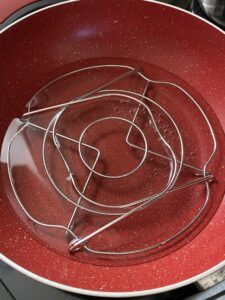
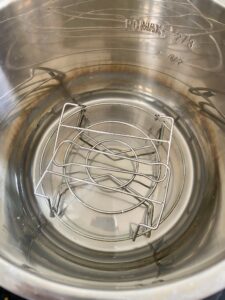
- a wide-band stainless steel ring (1-2 inches high) can also be used as a trivet to support the steamer plate above the water in the pot - see picture below
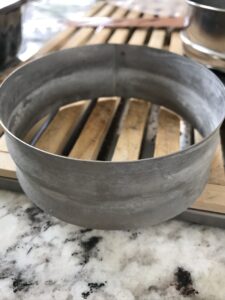
- Check the size of your steaming plate: place the empty steaming plate on the trivet to make sure it fits comfortably, and without wobbling.
- If it is too tight, it will be difficult to remove the plate from the steamer (after steaming is done)
- If it is too tight, use a slightly smaller plate for steaming.
- Try to lift it out with tongs, as a trial run - to make sure you can do so after steaming.
- If it is too tight, it will be difficult to remove the plate from the steamer (after steaming is done)
- Cover the pot with the lid (for pressure cooker/Instant Pot, keep the pressure vent/valve open) and begin heating
- i.e., "zero-pressure" cooking.
- When the water starts boiling, the steamer is ready for steaming the Dhokla batter.
ENO not available?
Here's an easy 'Do It Yourself' mixture that works quite well as a substitute for ENO:- Mix 1/2 tsp + 1/8 tsp Citric acid with 1/2 tsp Baking soda in a dry bowl
- Transfer to a dry mortar and crush to a fine powder with a pestle
- Sift the mixture through a fine mesh strainer
- if you see lumps, transfer them back to the mortar and grind to a powder again
- Sift through the mesh strainer again.
- Use this mixture instead of ENO as described in the Recipe directions
Storing Leftovers
Store leftover Dhokla in a lidded glass/ceramic container. In the refrigerator :- Use within 2-3 days,
- To serve, warm it gently in the microwave ( 20-30% power) till barely lukewarm
- If it looks 'dry', splash a little water all over before warming
- Add fresh garnish if possible
- fresh chopped coriander (cilantro)
- Good for 3-4 weeks, maybe longer
- Thaw in the refrigerator overnight
- To serve, warm it gently in the microwave (20-30% power) till barely lukewarm
- If it looks 'dry', splash a little water all over before warming
- Add fresh garnish if possible
- fresh chopped coriander (cilantro)
Nutrition
Serving: 5PiecesCalories: 143kcalCarbohydrates: 20gProtein: 6gFat: 4gSaturated Fat: 1gPolyunsaturated Fat: 1gMonounsaturated Fat: 2gSodium: 433mgPotassium: 280mgFiber: 7gSugar: 3gVitamin A: 410IUVitamin C: 12mgCalcium: 101mgIron: 2mg
Tried this recipe?Let us know how it was!